The best onboarding is no onboarding.
An AI-powered ingestion system for SourceDay that automates procurement workflows without asking suppliers to adopt new tools.

ABOUT SOURCEDAY
↗SourceDay is a supply chain collaboration platform that helps manufacturers, distributors, and suppliers manage purchase order (PO) changes, supplier communication, and procurement workflows more efficiently. It replaces manual processes, like spreadsheets and email, with automated, real-time tools that improve visibility, accuracy, and accountability across the purchasing lifecycle.
PROJECT SUMMARY
The biggest friction point in procurement software isn't the software — it's the suppliers who won't use it. Large suppliers have their own systems, their own processes, and zero interest in logging into a customer's portal. For years, that meant buyers were stuck: automate the suppliers willing to adopt new tools, manually handle everyone else.
Intelligent Document Processing (IDP) was the decision to stop asking suppliers to change. Instead of building a better portal, we built a system that works with what suppliers already send — PDFs, spreadsheets, reply emails — and makes them part of the workflow anyway. That reframe was the insight. The product follows from it.
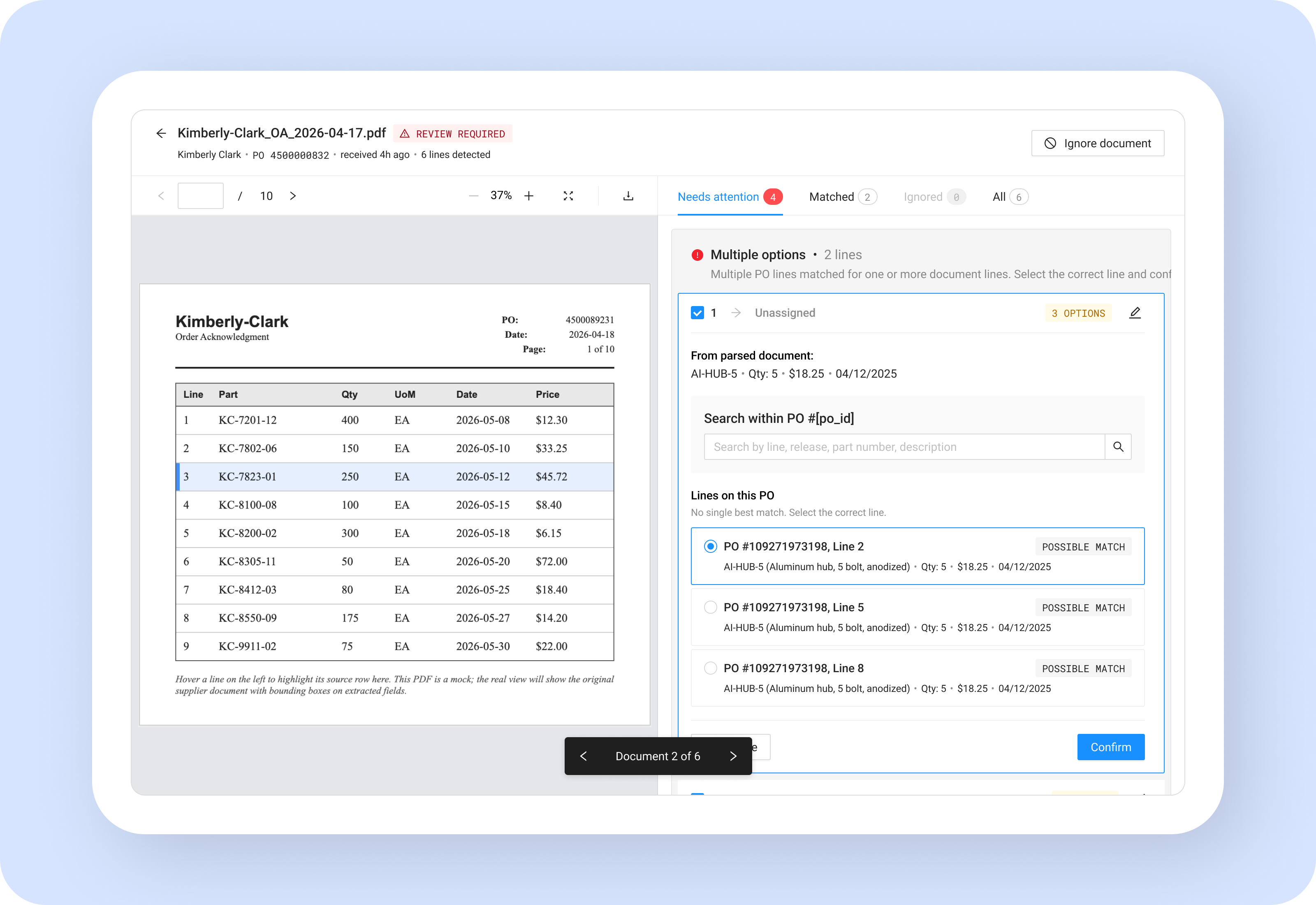
Why it matters to customers
For buyers, the daily reality before IDP is someone opening email attachments and re-typing numbers into an ERP. Not once — for every order acknowledgment, from every supplier, every day. It's slow, error-prone, and scales with headcount instead of volume.
IDP changes the economics. Clean matches push to the ERP automatically. The buyer only sees exceptions: a price discrepancy, a delayed date, an ambiguous line item. Their job shifts from data entry to decision-making.
The broader value is coverage. Customers told us they wanted more of their supply chain in SourceDay, but suppliers kept opting out. We see IDP as the remaining tech that solves for these suppliers, as it doesn't require them to opt in to anything. They keep working the way they work. The customer gets the visibility and automation to improve their job.

USER RESEARCH
Before designing anything, we needed to understand three main things:
- What type of automations are set up on the suppliers side to accept purchase orders
- What buyers actually do when an acknowledgement lands in their inbox today
- And, whether supplier documents were consistent enough to automate against at all
What we heard from buyers. Matching acknowledgments to POs was a manual, email-based process. When something was off, buyers called or emailed the supplier directly. "WILL ADVISE" and "TBD" entries had no standard handling — buyers either chased or guessed. And when asked what they'd expect if a supplier flagged a change but wouldn't log into SourceDay to resolve it: every buyer said email, same as always.
What we saw in the documents. The variance was significant. Some acknowledgements were clean and structured; others had missing line numbers, bundled SKUs, non-standard units of measure, or "back ordered" flags that were ambiguous about cancellation vs. delay. Real-world match rates without vetted templates were around 60% — not a conservative estimate.
What we heard from suppliers. Discovery calls with multiple large suppliers confirmed PDFs are the main format for inbound POs. Additional formats, such as CSV, would round out the list of document types. Retraining to SourceDay’s PO PDF might be a point of friction.
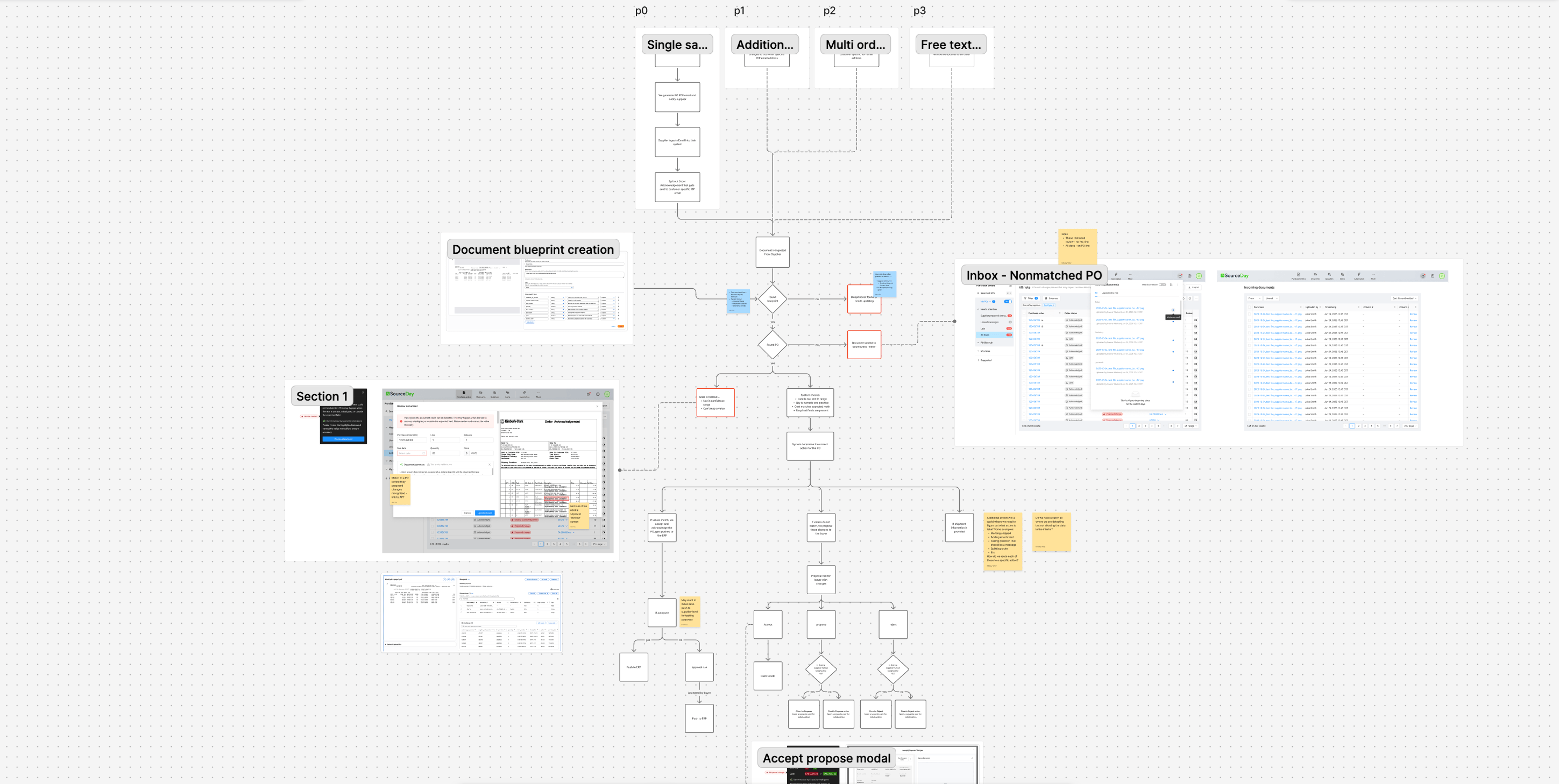
PRODUCT OPPORTUNITY
Our research found the following to be true:
- The buyer sessions killed the idea of a fully automated, hands-off system. Buyers wanted exceptions surfaced, not hidden. That became the core design principle: eliminate the easy work, not the human judgment.
- The document analysis produced the four match statuses directly. The edge cases we saw in real PDFs — ambiguous line identity, changed values, missing data — couldn't collapse into a pass/fail model without losing the information buyers needed to act.
- The supplier discovery session expanded the ingestion spec beyond PDFs early, before it became a build problem.
- And the "suppliers won't log in" finding confirmed the exception loop had to stay in the buyer's hands — closing the loop via email, not a supplier portal action.
Early prototypes to understand interaction patterns
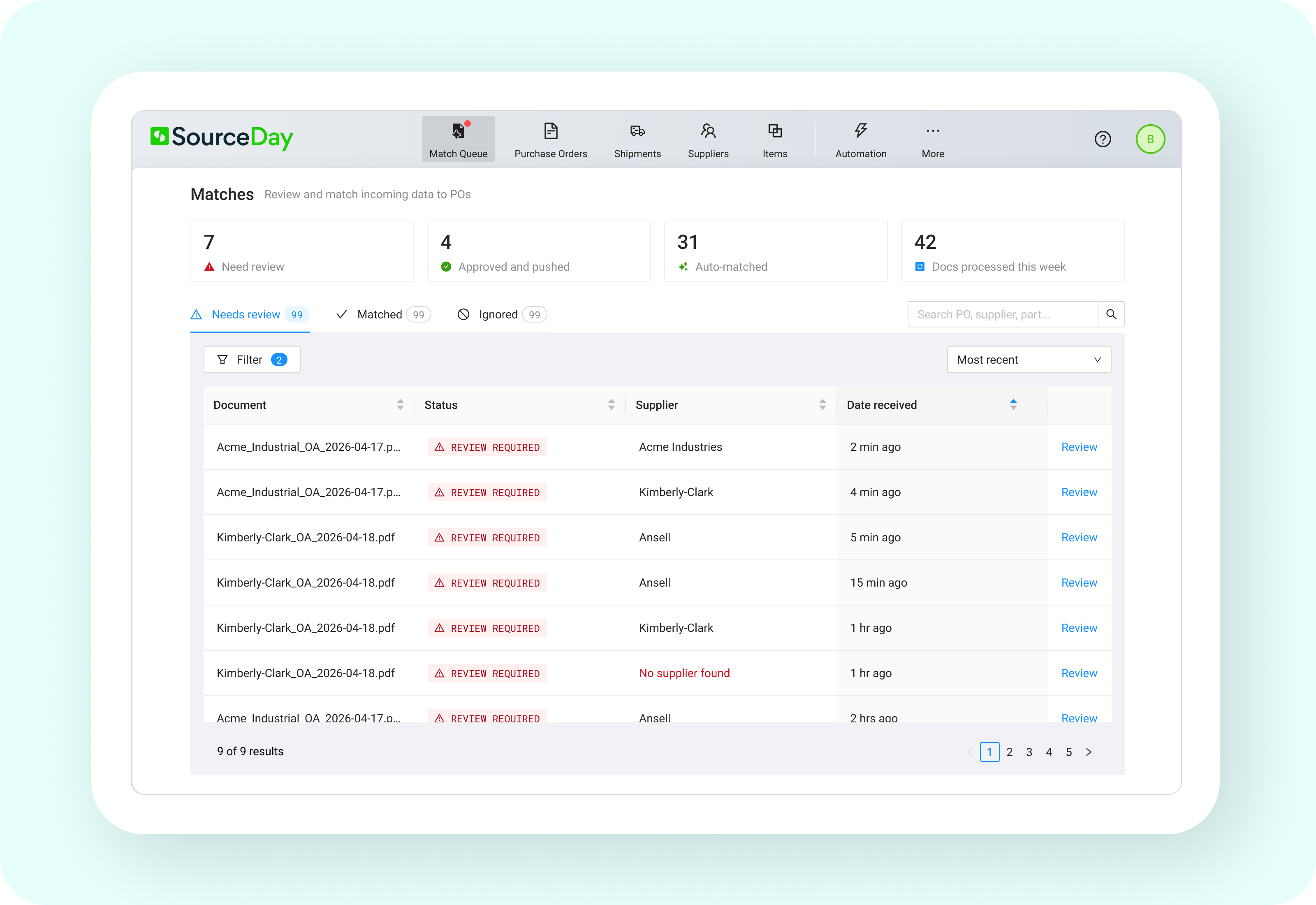
Match Queue – flagging only the documents that need review
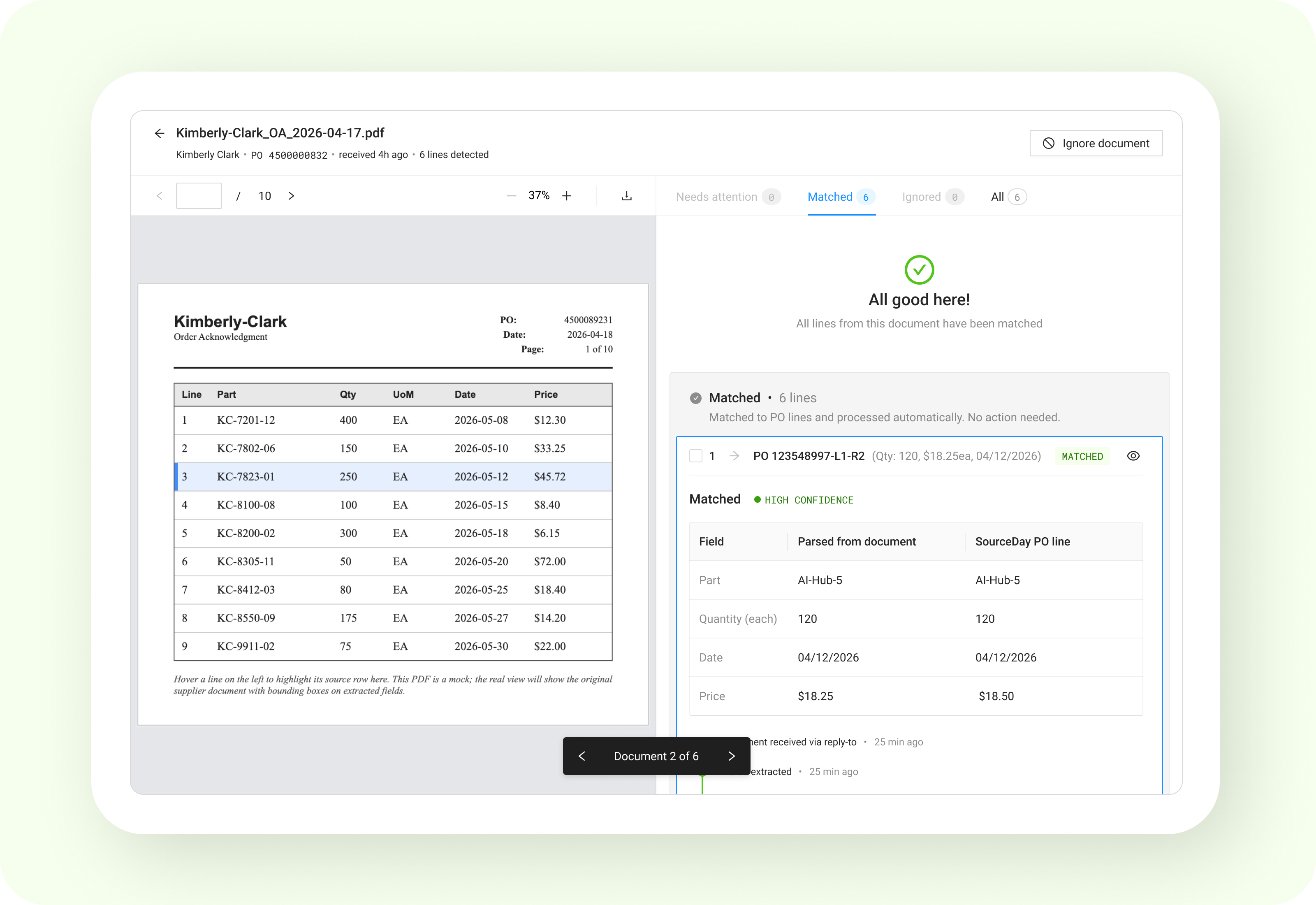
No user action needed when all lines are matched
CORE DECISIONS THAT DEFINED THE PROJECT
The hardest part of this project wasn't building the automation — it was deciding what not to automate.
Resisting full autonomy. The easy pitch is "the system handles everything." The honest product is an exception-management tool: clean matches push automatically, everything else goes to the buyer. We made that call because the failure modes of silent errors are worse than the cost of a review queue. The product's job is to eliminate the easy 70%, not to pretend the hard 30% doesn't exist. This review queue is the differentiator for SourceDay, giving buyers confidence in what gets written back to their ERP.
Hiding confidence from buyers. The LLM produces a confidence score for every match. We chose not to show it. Surfacing a number like "84% confident" creates more questions than it answers. Instead, the system translates confidence into routing: high confidence auto-pushes, low confidence surfaces for review, ambiguous routes to unconfirmed match. Buyers see outcomes, not probabilities. That's a design decision, not a technical one.
WHAT SUCCESS LOOKS LIKE
As we enter a beta period, we’ll aim for 95% of order acknowledgments from enabled suppliers auto-matched, 70% auto-pushed to the ERP without buyer intervention, field extraction accuracy at 98% or above.
The metric we're watching most carefully over time: the percentage of a buyer's total supplier base interacting with SourceDay. Auto-match rate measures quality within the system. Supplier coverage measures whether IDP is actually expanding what the product can do for a customer — turning suppliers who were previously unreachable into part of the workflow.
That's the real measure of whether the reframe worked.


